Free practice · no account
Describe a picture in Norwegian
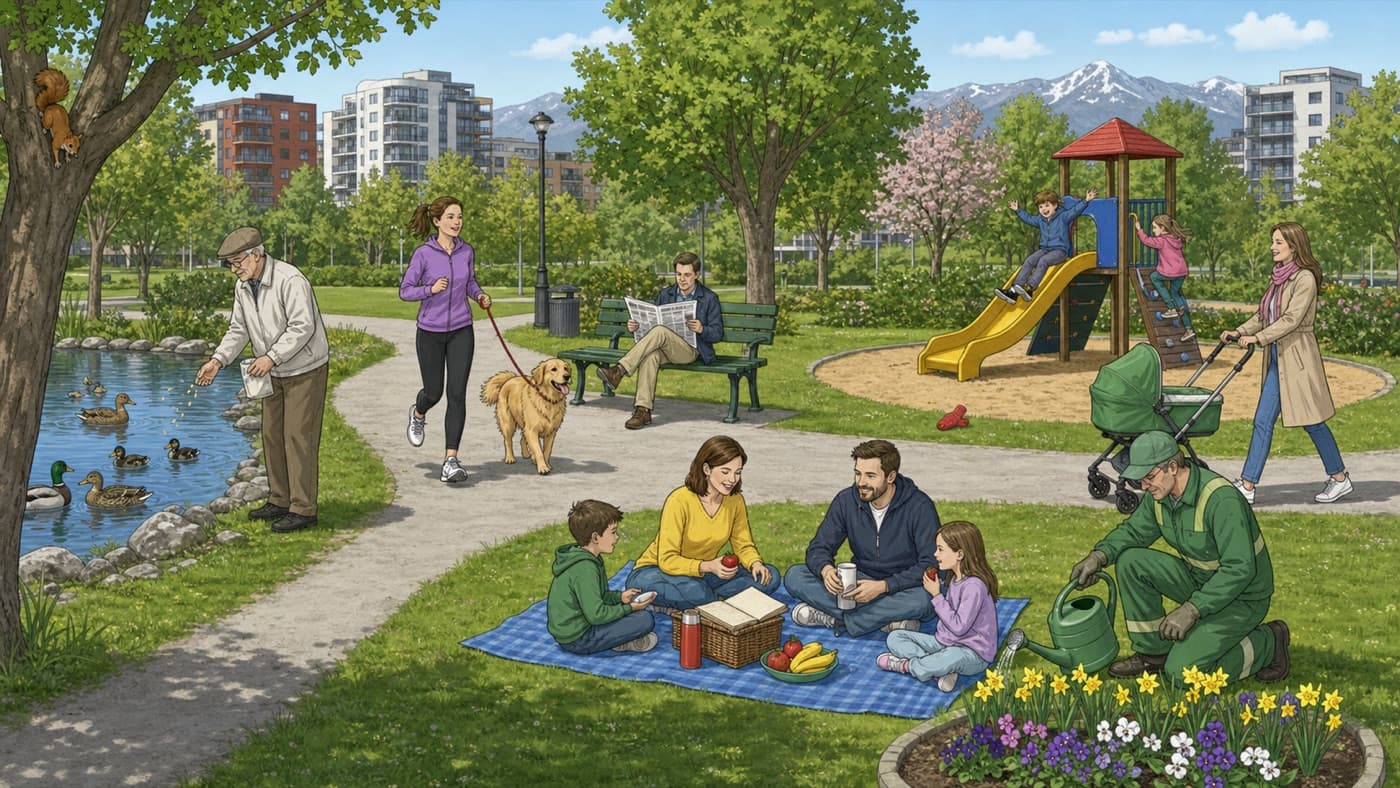
One of the tasks in the Norwegian oral test is to look at a picture and talk about it. Below is a real practice picture and three of its lines — you'll see the English, say the Norwegian out loud, record it, and hear yourself against a native Oslo voice. It's the drill from the app, running here, free.
Say it in Norwegian
The picture shows a park on a sunny day.
What a finished answer sounds like
Single lines are how you practice. On the day you string them together and keep going. Here is the same picture described at three lengths, so you can hear where you're aiming:
Where you start — the three sentences that get you talking. Too short to stop here.
Bildet viser en park på en solrik dag. En eldre mann mater endene. Flere ender svømmer i vannet.
The order that stops you stalling
Most people freeze on this task not because the Norwegian is hard but because they run out of things to say in the first ten seconds. Going through the picture in a fixed order fixes that — each frame hands you the start of a sentence:
Bildet viser …
The picture shows…
Til venstre …
On the left…
Til høyre …
On the right…
I bakgrunnen …
In the background…
Det ser ut som om …
It looks like…
Jeg tror …
I think…
You will not need all six. Two or three, used in order, are enough to carry a minute of speech.
Where this task fits in the test
The picture comes up in the individual part, where you speak on your own for a couple of minutes and then answer a few follow-up questions. It is one of four tasks — the others are the introduction, a conversation with the other candidate, and an opinion question.
Common questions
How do you describe a picture in Norwegian in the oral test?+
Say what the picture shows, then work through it in a fixed order so you never stall: start with «Bildet viser …» (the picture shows…), place people and things with «Til venstre …» and «Til høyre …» (on the left / on the right), then add a guess with «Det ser ut som om …» (it looks like…) or «Jeg tror …» (I think…). You are not being marked on vocabulary — you are being marked on keeping going in clear, connected sentences for a minute or two.
How long should my picture description be?+
Longer than most people expect. You have the floor on your own for a minute or two, so three or four sentences will run out long before the task does — plan to keep going until the examiner moves you on. The model answer here is recorded at three lengths for that reason: the short one is where you start, and the longest is the one to aim for on the day. Note that the longest version is not harder Norwegian — it is the same simple sentences with more of the picture described.
What tense should I use to describe a picture?+
Present tense, throughout. «En mann leser en avis» (a man is reading a newspaper), not the past. Norwegian has no separate continuous form, so «leser» covers both "reads" and "is reading" — one less thing to think about.
Do I need advanced vocabulary to pass this task?+
No. The sentence bank on this page is ordinary A2 vocabulary — park, dog, newspaper, children, bench. What examiners listen for is whether you can produce connected sentences without long silences, not whether you know an unusual word. Simple and fluent beats ambitious and stuck.
Is this the real exam picture?+
No — the actual pictures are not published in advance. This is a practice picture built to the same brief: an everyday scene with several people doing recognizable things. The task wording, the answer structure and the level are the same as the real thing, which is what you can usefully rehearse.
Can I practice this for free?+
This page is free and needs no account — the picture, the model answers, the native audio and the record-and-compare all work as they are. The rest of the picture set, the B1 sentence banks, the other voices and the answer check are part of Norskprøven.ai.
The practice picture and answers here are illustrative — they are not the actual exam materials, which vary and are not published in advance. Norskprøven.ai is an independent practice tool, not affiliated with HK-dir or UDI.